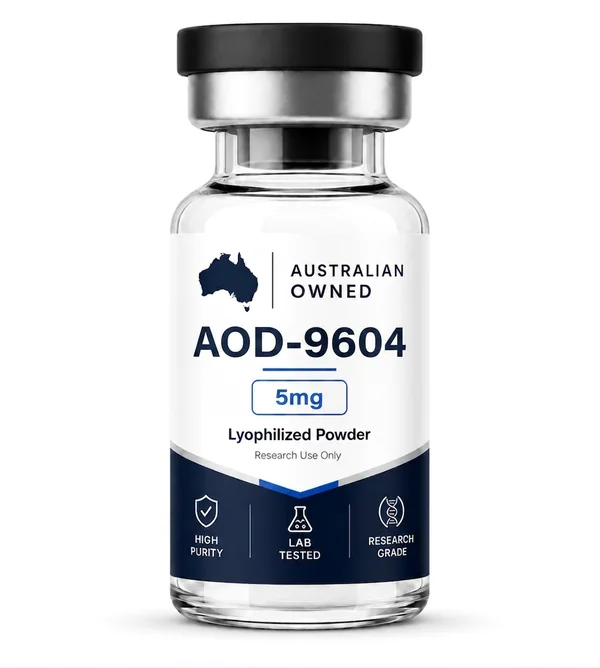
A comprehensive practical manual for Australian researchers working with AOD-9604: covering intake verification, reconstitution steps, storage parameters, and audit-ready tracking.
Within Australian scientific facilities, AOD-9604 continues to be an essential subject of ongoing metabolic and peptide chemistry investigations. This bench-side reference outlines the critical quality-control checkpoints, reconstitution parameters, stability guidelines, and supply chain standards required for reliable experimental outcomes.
Following a systematic intake-to-disposal workflow ensures laboratory compliance and eliminates data-compromising variables at every experimental milestone.
Phase 1: Receiving and Inspecting AOD-9604 Shipments
- Collect incoming deliveries promptly from dispatch points to minimise exposure to high ambient Australian temperatures.
- Cross-reference the packaging lot identifiers directly against the tracking notice issued for your AOD-9604 order.
- Examine the lyophilized plug under direct light to confirm a uniform, solid white structure free of collapsed or glassy regions.
- Archive an intake photograph capturing the packaging label, vial markings, and corresponding paperwork for internal compliance files.
Phase 2: Analytical Certificate and Quality Verification
Prior to transferring any peptide into cold storage, complete a rigorous audit of the accompanying testing certificates. This swift cross-check guarantees your materials match validated synthesis benchmarks.
- Confirm that the lot codes printed on the glass vial, exterior carton, and analytical document match seamlessly.
- Ensure analytical purity meets or exceeds 98% via high-performance liquid chromatography (HPLC) with full spectrum traces visible.
- Validate the observed molecular mass via mass spectrometry (MS) against the theoretical target for AOD-9604.
- Register the batch details into your laboratory inventory software linked to the authenticated test document.
Confirm Batch Authenticity Prior to Hydration
Access fully documented laboratory testing files and match lot numbers directly from our open analytical database.
Phase 3: Step-by-Step AOD-9604 Reconstitution
| Step | Action | Failure mode prevented |
|---|---|---|
| 1 | Room-temp vial and BAC water | Thermal shock on the lyophilized cake |
| 2 | Swab both stoppers | Contamination from needle pass-through |
| 3 | Slow injection down the wall | Foaming and denaturation |
| 4 | Gentle swirl, no shake | Mechanical degradation of the peptide |
| 5 | Label with date and concentration | Ambiguity later in the study cycle |
| 6 | Refrigerate at 2–8°C | Stability loss outside cold storage |
Order High-Purity AOD-9604 in Australia
Explore premium research-grade peptides with complete batch documentation and secure local dispatch across Australia.
Phase 4: Post-Reconstitution Preservation Guidelines
- Store reconstituted solutions continuously at 2–8°C in sterile bacteriostatic diluent.
- Conclude study protocols within the recommended stability window, generally 28 to 42 days for this sequence.
- Prepare single-use aliquots at the initial mixing stage to avoid degradation from repeated rubber stopper coring.
- Shield reconstituted vials from direct UV exposure, interior lighting, and fluctuating storage conditions.
Phase 5: Study Completion and Inventory Reconciliation
As each vial is depleted or reaches its stability cutoff, record the final dispensed volumes and follow approved biological waste handling procedures. Entering these end-of-life notes against the primary batch code maintains audit integrity for upcoming studies.
Phase 6: Replenishing Your Laboratory Supplies
Securing additional AOD-9604 through Klow Peptide maintains consistent testing conditions thanks to domestically warehoused inventory, third-party lot testing, and rapid transit. If your team requires tailored batch volumes, reach out to support@klowpeptide.com.au to coordinate fulfillment.
Speak with the Klow Peptide Technical Team
Connect with our domestic support team for technical documentation, delivery timelines, and institutional batch orders.
Frequently Asked Research Questions: AOD-9604
Can unmixed AOD-9604 remain at ambient room temperature?
Freeze-dried peptide powder handles short-term transit temperatures safely. For sustained preservation, vials should be stored at -20°C in a humidity-controlled freezer.
What is the expected viability of AOD-9604 once reconstituted?
When prepared with bacteriostatic water and held between 2°C and 8°C, the reconstituted solution typically retains integrity for 28 to 42 days.
What procedure applies if my shipment arrives warm?
Record thermal indicators and photograph the parcel immediately, then notify Klow Peptide within 24 hours. We arrange a rapid replacement if thermal degradation has compromised product stability.
Is it safe to freeze reconstituted AOD-9604 solutions?
Freeze-thaw cycles can rupture peptide peptide chains. If prolonged storage is necessary, split into individual single-use aliquots before freezing once only.
How should our lab track multi-week usage of a single batch?
Maintain an active lab log registering hydration date, target concentration, draw amounts, and the master lot number, allowing full trace-back to the primary COA.
How do researchers access the most recent AOD-9604 certificates of analysis?
Our online Lab Results repository provides instant access to current third-party testing documentation, and a physical copy is included inside each Klow Peptide order.
Source Verified AOD-9604 for Laboratory Work
Australian domestic dispatch, strict quality controls, and transparent analytical documentation for every lot.