
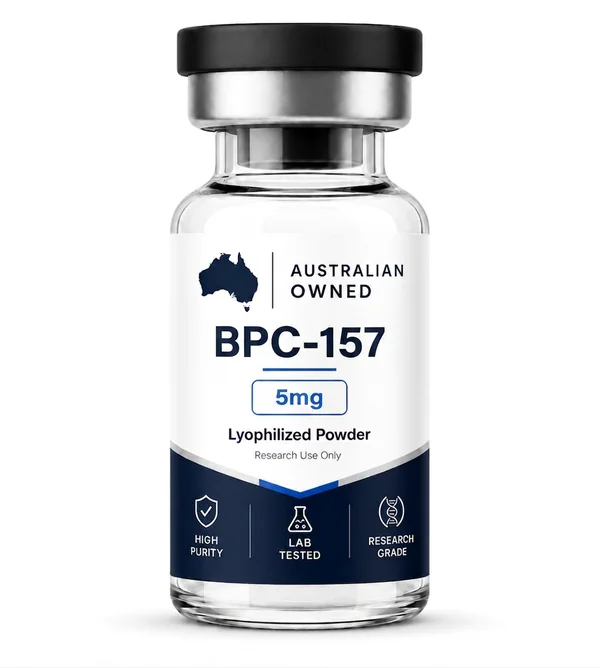
A technical compilation of published preclinical benchmarks and analytical considerations surrounding BPC-157 dosage for Australian research settings.
Preclinical papers evaluating the pentadecapeptide Body Protection Compound-157 present a wide spectrum of experimental quantities across tissue culture, murine, and lagomorph models. Synthesising this published data helps laboratory personnel establish reproducible parameters for in vitro assays, serving strictly as an academic reference point.
Establishing a framework around bpc 157 dosage requires consulting peer-reviewed methodology rather than speculative commentary. For Australian investigations entering protocol design, correlating recorded concentrations from primary studies with rigorous batch analytics provides the foundation for reliable, repeatable findings.
Biological Pathways and Concentration Context in the Literature
Mechanistic evaluations indicate that experimental concentrations influence downstream angiogenic pathways, nitric oxide synthase expression, and focal adhesion kinase activity. Research facilities assessing bpc 157 dosage typically consult initial peptide characterisations and subsequent stability trials to calibrate their working assays.
While comparative studies against related regenerative signalling molecules offer theoretical baseline context, published literature cannot compensate for variable vial purity or degraded material. Direct analytical verification remains essential for empirical consistency across trial runs.
The Necessity of Comprehensive Batch-Specific Analytics
Vials marked with identical nominal values can yield divergent assay outcomes if peptide salt fractions, counter-ions, or synthetic degradation products vary. Independent testing via chromatography and spectrometry confirms exact molecular identity, ensuring observed outcomes reflect the compound rather than synthesis artefacts.
Calculate Your Working Reconstitution Volumes
Accurately compute diluent additions and aliquot concentrations with our laboratory utility.
Essential Verification Records for Peptide Trials
| Analytical Record | Functional Role | Review Stage |
|---|---|---|
| Certificate of Analysis (Lot-Specific) | Validates compound identity and relative chromatographic purity | Prior to diluent introduction |
| HPLC Spectral Graph | Provides visual verification of trace synthesis impurities | Prior to diluent introduction |
| Mass Spectrometry (MS) | Matches experimental mass against the expected theoretical value (1419.5 Da) | Prior to diluent introduction |
| Cold-Chain Dispatch Log | Tracks ambient thermal exposure between depot release and receipt | Upon lab check-in |
| Laboratory Preparation Log | Documents reconstitution time, bacteriostatic agent, and final concentration | At compounding phase |
Order High-Purity BPC-157 for In Vitro Work
Every batch is verified by HPLC and dispatched domestically from Australian stock with full tracking.
Standard Laboratory Reconstitution Procedure
- Equilibrate the lyophilised peptide vial and bacteriostatic diluent to controlled ambient temperature (20–25°C).
- Decontaminate the elastomeric septum of each container using a sterile 70% isopropyl alcohol wipe.
- Introduce the calculated volume of bacteriostatic water steadily along the interior glass wall to avoid foaming.
- Gently roll or invert the vial until the lyophilised matrix dissolves into an optically clear fluid; do not vortex vigorously.
- Record preparation date, final dilution value, project ID, and operator credentials on the primary container.
- Transfer immediately to cold storage (2–8°C) and utilise within established chemical stability intervals.
Handling Parameters and Compound Preservation
- Lyophilised state: Preserve at -20°C in an unlit, desiccant-equipped environment to maintain long-term stability.
- Reconstituted state: Store between 2°C and 8°C using bacteriostatic water, typically maintaining structural integrity for 28 to 42 days under sterile handling.
- Avoid repetitive freeze-thaw cycles; divide into single-use aliquots during reconstitution if sub-zero storage is necessary.
Questions Concerning Batch Documentation?
Our domestic support staff can supply batch documentation, technical data sheets, and institutional order assistance.
Domestic Supply and Quality Control in Australia
Klow Peptide holds stock within Australia, avoiding overseas customs friction and uncontrolled environmental exposure during transit. Each batch is paired with public third-party chromatography, ensuring research professionals receive authenticated compounds supported by local customer assistance during standard Australian operating hours.
Answers to Common Technical Inquiries
How can researchers verify the specific batch purity of BPC-157?
Batch-matched Certificates of Analysis are available via our dedicated Lab Results portal, and printed analytical copies accompany each shipment from Klow Peptide.
What purity threshold is maintained for research-grade BPC-157?
Klow Peptide enforces a minimum purity specification of ≥ 98% by reverse-phase HPLC, with numerous production batches exceeding 99%.
What temperature profile is required once the peptide is dissolved?
Reconstituted solutions should be stored refrigerated at 2–8°C, maintained in sterile conditions, and evaluated within the 28–42 day window recommended by stability data.
Are archival test records obtainable for previous experimental runs?
Yes. If an older lot number is required for replication or audit records, contact support@klowpeptide.com.au for historical analytical files.
Is BPC-157 permitted for diagnostic or clinical applications?
No. Material supplied by Klow Peptide is exclusively intended for laboratory experimentation and in vitro assays within Australia, not for medical, veterinary, or human use.
Why is third-party testing critical when sourcing research peptides?
Unverified sources may suffer from peptide truncation, net content inaccuracy, or heavy-metal contamination. Independent HPLC and MS data confirm precise chemical integrity before unboxing.
Source Authenticated Peptides for Your Laboratory
Order analytical-grade BPC-157 shipped rapidly across Australia with full verification paperwork.