A practical technical overview of GHK-Cu (copper tripeptide-1) for Australian research facilities: analytical validation, reconstitution steps, and domestic shipping logistics.
The compound GHK-Cu represents the copper(II) chelate of the small tripeptide glycyl-L-histidyl-L-lysine. Originally isolated during investigations into human serum fractions, it remains one of the most widely cited peptide complexes in experimental matrix remodeling and cell-signaling research across international scientific literature.
Australian research teams evaluating ghk cu require direct technical specifications, transparent analytical data, and dependable local fulfillment rather than promotional filler. Below, we address the critical operational and chemical questions surrounding ghk cu, followed by verification protocols to confirm quality prior to experimental work.
Core questions: GHK-Cu procurement in Australia
Does Klow Peptide warehouse ghk cu domestically in Australia?
Yes. Klow Peptide maintains all listed ghk cu units in our domestic facility, enabling immediate dispatch across Australia without international customs exposure.
What analytical purity standard is guaranteed?
Every release of ghk cu is certified at ≥ 98% purity verified via analytical high-performance liquid chromatography (HPLC), with corresponding chromatograms provided on each COA.
Is batch-specific documentation supplied with the peptide?
Yes. Each order includes a matching, lot-specific Certificate of Analysis. Analytical records for active batches are also permanently accessible via our online lab results directory.
What is the expected transit window for domestic orders?
Orders confirmed before the dispatch cut-off ship via Express Post, typically arriving at metropolitan Australian locations within 1 to 3 business days.
Secure Analytical-Grade GHK-Cu for Your Lab
Direct domestic dispatch of verified ghk cu with synchronized vial, packaging, and COA traceability.
Technical profile: GHK-Cu peptide mechanics
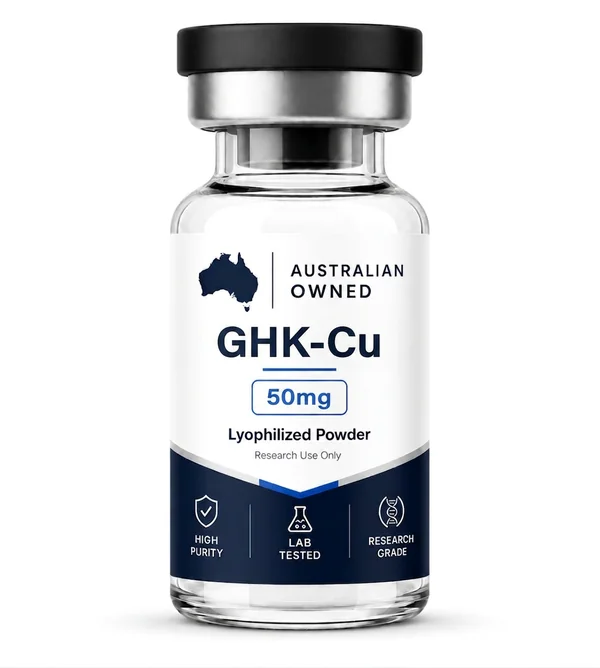
Supplied as a deep-blue lyophilized cake, ghk cu is prepared strictly for in vitro assays and laboratory evaluation. For experimental trials, research personnel typically reconstitute the powder using sterile bacteriostatic water, adjusting total diluent volume to establish target working concentrations. Comprehensive characterization and molecular confirmation should always be verified against the manufacturer's analytical certificate.
Primary investigational settings for GHK-Cu
- University and institutional laboratories investigating cellular signaling pathways and gene expression modulation.
- Analytical assay groups establishing reference standards and chromatogram comparisons.
- Biochemical research programs studying metallopeptide affinities and matrix degradation kinetics.
- Australian research facilities requiring consistent, scalable inventory for multi-stage research projects.
Calculate Dilution Parameters
Establish exact solvent volumes and target aliquot concentrations before initiating reconstitution.
Rapid 4-step quality audit for incoming batches
- Audit the printed lot number on the primary glass vial against the external carton and the corresponding COA document to confirm identity matching.
- Inspect the HPLC analytical profile to confirm an overall purity readout equal to or exceeding 98.0%, ensuring the raw chromatogram trace is visible.
- Review the mass spectrometry report to verify that the identified molecular mass strictly corresponds with theoretical values for the copper-chelated complex.
- Verify the synthesis date, confirming receipt within a 12-month manufacturing cycle to preserve optimum stability.
Laboratory reconstitution workflow
| Phase | Laboratory Procedure |
|---|---|
| Phase 1 | Equilibrate the lyophilized vial and diluent to ambient temperature (20–25°C) |
| Phase 2 | Sanitize the vial septum and diluent access point using an isopropyl swab |
| Phase 3 | Introduce bacteriostatic water down the internal glass wall at a gradual rate |
| Phase 4 | Swirl gently until completely dissolved; avoid aggressive agitation or foaming |
| Phase 5 | Affix batch and date labeling, then store the solution refrigerated at 2–8°C |
Connect with the Klow Peptide Technical Desk
Questions regarding batch data, shipping windows, or bulk research orders are managed directly by our domestic staff.
Purchasing terms and order fulfillment
The catalog price for ghk cu at Klow Peptide is based on independent HPLC verification, stable domestic cold-storage handling, and transparent documentation for every lot. Australian researchers can complete payment through multiple secure channels, including bank transfer, credit card, and digital assets. Processing timelines and order settlement requirements are outlined on our payment guidance page.
Additional operational inquiries
Are institutional volume discounts available for ghk cu?
Yes. We offer tiered institutional rates for commercial testing facilities, university departments, and ongoing high-volume research protocols.
What assistance is provided if an order is held up in transit?
Our support desk actively monitors domestic parcel routing. If an Express shipment displays no movement for more than 48 hours, contact support@klowpeptide.com.au for resolution.
Is parcel packaging unmarked?
Yes. Every shipment leaves our warehouse in neutral, unbranded exterior packaging to maintain research confidentiality and secure handling.
Can independent researchers review the current batch COA prior to purchase?
Certainly. Analytical documentation for all active inventory lots is freely accessible on our public lab results page before placing an order.
Source Verified GHK-Cu for Scientific Research
High-purity lyophilized peptides backed by full analytical transparency and fast Australian dispatch.