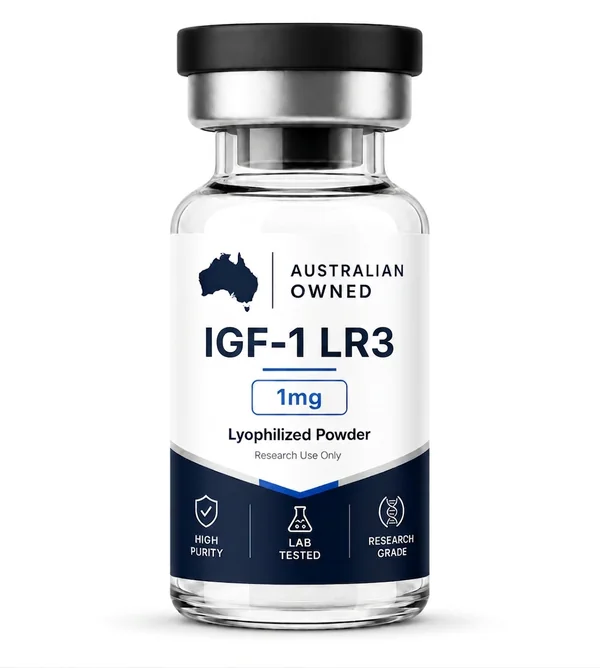
A comprehensive procedural workflow for handling, documenting, reconstituting, and storing recombinant IGF-1 LR3 in Australian research laboratories.
IGF-1 LR3 (Long R3 Insulin-Like Growth Factor-1) represents an 83-residue engineered peptide analogue designed with a Glu-to-Arg substitution at site 3 alongside a 13-residue N-terminal extension. These structural alterations diminish its affinity for endogenous IGF-binding proteins (IGFBP), thereby substantially prolonging its physiological half-life compared to endogenous IGF-1 in assay models.
For investigators across Australia utilising igf-1 lr3, standardising procedural controls across each phase—from package intake and analytical verification to reconstitution, maintenance, and final archival—prevents baseline experimental drift. Below is a structured laboratory handling blueprint.
Phase 1: Intake & Physical Inspection
- Collect the delivered parcel immediately upon arrival to limit thermal exposure during hot Australian transit periods.
- Cross-check the secondary packaging lot numbers against your Klow Peptide shipping confirmation.
- Assess the lyophilised igf-1 lr3 cake through clear glass; it should appear intact, uniform, and free of moisture or shrinkage.
- Capture photographic verification of the package, vial label, and documentation to archive in your facility's database.
Phase 2: Analytical Chain of Custody & Verification
Prior to storing lyophilised igf-1 lr3 below freezing, researchers should cross-reference incoming analytical documentation. Completing this intake check protects in vitro models from lot-to-lot variances.
- Cross-examine the vial identifier, packaging tag, and analytical Certificate of Analysis (COA) to guarantee 100% concordance.
- Verify that HPLC analysis reflects ≥98% purity, inspecting the baseline clarity across the chromatogram.
- Review the electrospray mass spectrometry report to ensure the observed molecular weight corresponds to theoretical igf-1 lr3 constants.
- Upload the batch documentation directly into internal inventory tracking files alongside the study run number.
Essential Laboratory Calculators & Standards
Determine exact volumes, browse batch analytics, and review our documented quality benchmarks.
Phase 3: Systematic Reconstitution Protocol
| Stage | Procedural Action | Risk Mitigated |
|---|---|---|
| 1 | Equilibrate vial and bacteriostatic solvent to ambient lab temperature | Thermal shock and precipitation of the lyophilised matrix |
| 2 | Sanitise septum surfaces thoroughly with 70% isopropanol | Exogenous microbial ingress through the needle entry |
| 3 | Dispense diluent smoothly along the interior glass wall | Protein turbulence, foaming, and secondary structure denaturation |
| 4 | Gently swirl until dissolved; strictly avoid agitation | Mechanical shear stress breaking peptide bonds |
| 5 | Annotate final concentration and preparation date on vial label | Ambiguity in future multi-assay experimental schedules |
| 6 | Transfer solution immediately to 2–8°C dark refrigeration | Accelerated thermal degradation outside controlled cold chains |
Source High-Purity IGF-1 LR3 for Australian Research
Every vial of igf-1 lr3 is analytically validated by HPLC and dispatched domestically via tracked Express Post.
Phase 4: Long-Term Reconstituted Stability
- Maintain liquid igf-1 lr3 in continuous cold storage between 2°C and 8°C following dissolution in bacteriostatic water.
- Plan assay usage within empirical stability windows, typically between 28 and 42 days for refrigerated analogues in this class.
- Divide the reconstituted stock into single-use micro-aliquots initially if studies will continue over prolonged intervals, avoiding recurring needle punctures.
- Shield solutions from continuous ambient light and avoid fluctuating cycling conditions within the cooling unit.
Phase 5: Study Completion & Disposal Logging
When an experimental series completes or the vial meets its terminal operational window, record the depleted volume and follow laboratory bio-waste handling procedures. Maintaining batch disposition logs ensures complete chain-of-custody tracking across your active research inventory.
Phase 6: Securing Replacement Inventory
Procuring subsequent igf-1 lr3 lots through Klow Peptide delivers continuous batch traceability, rapid domestic Express transit from local inventory, and lot-verified purity. If custom assay requirements demand specific configurations, connect with our support desk beforehand to organise staged delivery.
Connect with the Klow Peptide Technical Team
Our Australian team can assist with order logistics, batch records, volume procurement, and handling specifications.
Frequently Asked Questions About IGF-1 LR3 Protocols
Is it acceptable to hold lyophilised igf-1 lr3 at room temperature?
Short intervals at ambient temperatures during postal delivery are acceptable for lyophilised peptide cakes. However, prolonged laboratory archiving should always be maintained at -20°C in hermetically sealed storage.
What is the expected working life of igf-1 lr3 once solubilised?
When preserved in bacteriostatic water at 2–8°C, igf-1 lr3 generally maintains stability for 28 to 42 days, depending on storage conditions and specific assay protocols.
How should our facility proceed if a shipment arrives thermally exposed?
Photograph the container immediately upon delivery and report the condition to support@klowpeptide.com.au within 24 hours. Klow Peptide will review the transit logs and arrange a replacement dispatch if integrity was affected.
Can dissolved igf-1 lr3 be placed in deep freeze?
Repetitive freeze-thaw cycles degrade complex protein structures. If sub-zero storage is necessary, partition the solution into single-use aliquots immediately after reconstitution rather than refreezing a working stock.
How should partial-draw vials be tracked during lengthy project timelines?
Document each aliquot draw volume, target concentration, and date in your lab management software, tying all experimental data directly back to the batch COA.
Where are analytical batch certificates for igf-1 lr3 accessed?
Laboratory analytical reports can be reviewed directly via the Klow Peptide Lab Results repository, while physical documentation is included with every research dispatch.
Procure Verified IGF-1 LR3 from Klow Peptide
Domestically stocked, independently tested, and ready for fast tracked Express dispatch across Australia.