
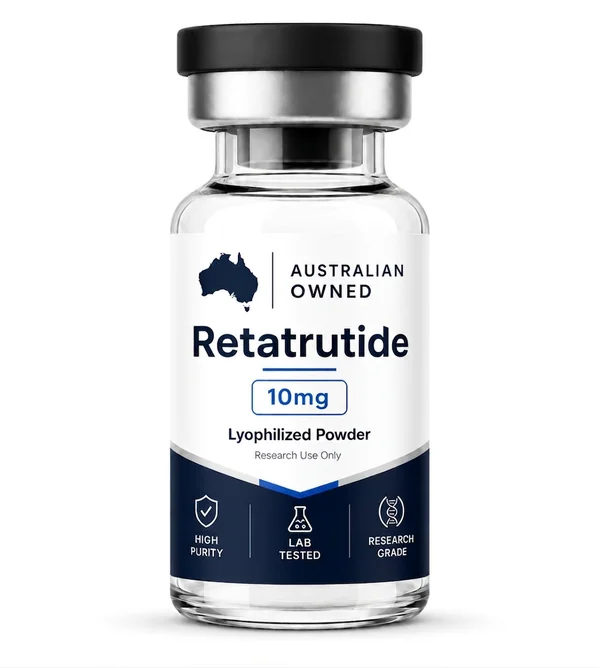
A comprehensive laboratory protocol for Australian researchers working with retarutide vic, covering intake validation, analytical documentation, reconstitution stability, and chain-of-custody controls.
Academic institutions and life-science facilities across Victoria and wider Australia frequently query "retarutide vic" when sourcing triple-agonist peptides for bench experiments. Navigating domestic procurement requires a clear understanding of vendor accountability, purity standards, and analytical chain-of-custody. Klow Peptide provides domestic researchers with dependable access to high-grade reference standards, eliminating the compliance hazards and clearance delays associated with offshore importing.
This standard operating reference breaks down the lifecycle of retarutide vic in Australian laboratories into six sequential stages: intake, analytical auditing, reconstitution, preservation, study consumption, and re-stocking. Implementing these safeguards protects experimental reproducibility and eliminates avoidable batch-loss vectors.
Phase 1: Physical Intake and Package Verification
- Process deliveries promptly upon arrival; avoid leaving thermal packaging in direct sun or unconditioned loading docks.
- Cross-reference the physical batch code on the secondary carton against your digital dispatch record for retarutide vic.
- Examine the lyophilized peptide plug through the clear borosilicate vial, confirming a solid, uniform cake free from moisture collapse or discoloration.
- Archive high-resolution intake images of the intact vial, label typography, and accompanying paper documentation into your inventory repository.
Phase 2: Analytical Chain-of-Custody and Certificate of Analysis Review
Before entering any peptide into primary refrigeration or deep-freeze inventory, your research staff should complete a mandatory verification of analytical documentation. This quick administrative step ensures complete lot integrity and safeguards against cross-batch variation.
- Confirm that the unique batch identifier matches identically across the vial base, box packaging, and lot-specific Certificate of Analysis (COA).
- Review the reverse-phase HPLC trace to confirm an overall purity threshold of at least 98.0%.
- Audit the high-resolution mass spectrometry (LC-MS) data to verify the molecular mass accurately aligns with theoretical retarutide specifications.
- File the analytical documentation within your laboratory information management system (LIMS) alongside your study codes.
Calculate Exact Diluent Volumes Before Processing
Determine precise reconstitution parameters, solvent volumes, and working microgram aliquots using our interactive benchtool.
Phase 3: Standard Operating Procedure for Reconstitution
| Step | Protocol Action | Experimental Risk Mitigated |
|---|---|---|
| 1 | Equilibrate peptide vial and sterile BAC diluent to ambient temperature | Thermal contraction and glass-surface shock of lyophilized cake |
| 2 | Sanitise septa with 70% isopropyl alcohol wipes | Particulate and microbial contamination during needle puncture |
| 3 | Introduce bacteriostatic water gradually down the internal glass wall | Denaturation of tertiary structure and excessive micro-bubble foaming |
| 4 | Employ gentle horizontal orbital swirling without vigorous shaking | Mechanical shear stress and covalent aggregation |
| 5 | Record reconstitution date, solvent type, and nominal concentration | Miscalculations during serial dilution workflows |
| 6 | Transfer to continuous cold-storage at 2–8°C | Rapid ambient-temperature hydrolysis and peptide degradation |
Acquire Certified Retarutide Vic for Domestic Research
Order analytically verified retarutide vic with Australian warehouse dispatch. Fast delivery via tracked Express Post across all Australian states.
Phase 4: Post-Reconstitution Preservation Guidelines
- Place reconstituted vials into 2–8°C refrigeration immediately following liquid dissolution.
- Plan experimental utilization within the accepted working stability window, generally 28 to 42 days for stabilized aqueous solutions in bacteriostatic water.
- Divide solution into single-use sterile micro-centrifuge tubes at initial reconstitution if tests span multiple weeks to mitigate repeated septum coring.
- Shield working solutions from ambient fluorescent exposure and direct UV radiation within light-impermeable containers.
Phase 5: Material Depletion and Assay Recording
When a vial of retarutide vic reaches volume completion or exceeds stability bounds, document the final draw, disposal protocol, and remaining tare weight in your study workbook. Maintaining exhaustive records guarantees full auditability and simplifies protocol matching when initiating downstream phases.
Phase 6: Reordering and Supply Chain Stability with Klow Peptide
Procuring replacement retarutide vic via Klow Peptide ensures continuity of baseline quality. Our materials remain domestically held with localized fulfillment, eliminating cross-border customs seizures and untracked transit delays. If your research trajectory requires tailored vial sizing or uniform master-lot reserving, connect with our domestic support team prior to placing your requisition.
Connect With Our Australian Support Desk
Our local team is ready to assist with analytical documentation, freight logistics, bulk reservations, and institutional orders.
Frequently Asked Questions: Retarutide Vic Lab Handling
Is ambient storage acceptable for lyophilized retarutide vic during transport?
Lyophilized material exhibits robust short-term stability during transit periods. However, once received in your facility, long-term preservation demands continuous deep-freezer storage at -20°C.
What is the stability timeline for retarutide vic once in solution?
When reconstituted with genuine bacteriostatic water and held at 2–8°C, the working solution typically retains analytical integrity for 28 to 42 days, depending on container seal and handling hygiene.
What steps should our team take if a consignment arrives elevated in temperature?
Record intake imagery immediately and reach out to Klow Peptide support at support@klowpeptide.com.au within 24 hours. We evaluate thermal exposures and authorize immediate replacement dispatches if lot integrity is compromised.
Can reconstituted solutions be frozen to prolong experimental usability?
Repeated freeze-thaw cycles frequently induce structural fragmentation and precipitation in tertiary peptides. If extended preservation is unavoidable, immediately aliquot into single-use vessels prior to freezing, and avoid refreezing after thawing.
How should we register partial vials utilized across longitudinal assays?
Document the initial reconstitution date, total working volume, individual draw amounts, and master lot number in your lab records so that all downstream trial observations remain trace-linked to a single verified COA.
Where can we verify current analytical certificates for our batch?
Batch-specific HPLC and mass spectrometry reports are accessible through our dedicated Lab Results section, and identical physical copies accompany every verified shipment from Klow Peptide.
Source Retarutide Vic from an Australian Supplier
High-purity lyophilized peptides tested via HPLC and LC-MS, dispatched from local stock via Express Post for research continuity.