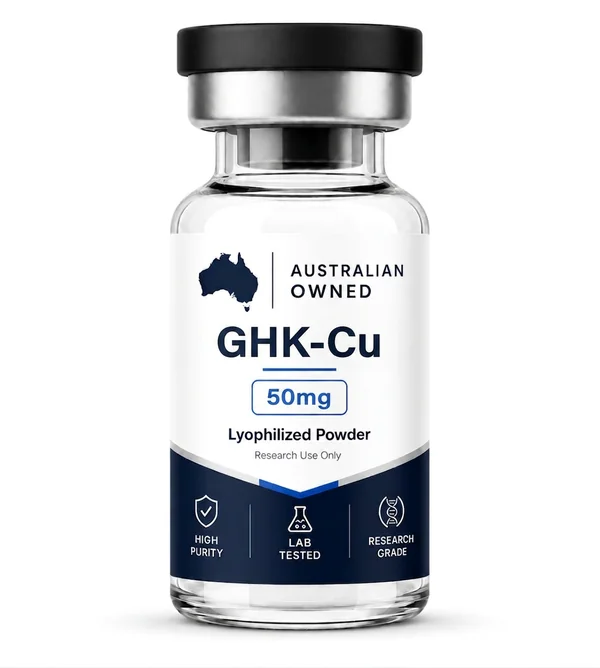
A definitive Australian laboratory guide for GHK-Cu exploring analytical verification, proper reconstitution practices, thermal stability profiles, and domestic procurement.
Copper peptide GHK-Cu remains a central focus within Australian biochemical and cellular research. Designing rigorous in vitro assays requires accurate compound specifications, reliable reconstitution workflows, and an uninterrupted chain of analytical documentation from an Australian supplier.
Because research parameters depend heavily on molecular fidelity, investigators across Australia need clear protocols rooted in published findings. This technical overview translates established scientific literature into practical criteria for laboratory storage, reconstitution, and domestic procurement.
Scientific Background and Proposed Biological Pathways
Initial characterisation studies established GHK-Cu as a high-affinity tripeptide complex with divalent copper. Australian research teams evaluating extracellular matrix synthesis, gene expression shifts, and tissue remodeling typically align their experimental parameters with baseline molecular weight and chelating characteristics reported in early literature.
While comparative studies involving non-chelated GHK or synthetic copper complexes provide broader context, baseline assay reproducibility depends entirely on the analytical integrity of the specific peptide lot being prepared on the bench.
The Necessity of Lot-Specific Third-Party Testing
Even subtle variances in peptide synthesis, freeze-drying parameters, or moisture content can alter dissolution rates and biological response in culture. Authentic Certificates of Analysis (COAs) derived from independent testing ensure that experimental outcomes reflect the pure molecule rather than counter-ion variations or synthesis impurities.
Essential Resources for Research Workflows
Calculate accurate reagent volumes, inspect verified chromatograms, and review our laboratory protocols.
Core Quality Assurance Paperwork for GHK-Cu Batches
| Analytical Record | Laboratory Function | Verification Stage |
|---|---|---|
| Lot-Specific COA | Attests to nominal purity score and precise target identity | Prior to vial unsealing |
| Analytical HPLC Scan | Quantifies relative chromatographic purity and separates trace impurities | Prior to reconstitution |
| Mass Spectrometry (MS) | Matches experimental mass-to-charge against theoretical molecular mass | Prior to assay setup |
| Cold-Chain Audit Trail | Documents thermal consistency from post-synthesis through delivery | Upon parcel intake |
| Bench Reconstitution Sheet | Records diluent lot, operator, final concentration, and timestamp | During solution prep |
Order High-Purity GHK-Cu from Australian Stock
Independent third-party HPLC tested GHK-Cu dispatched daily from our domestic facility via tracked Express Post.
Standard Laboratory Reconstitution Procedure
- Equilibrate the lyophilised GHK-Cu vial and bacteriostatic water to ambient lab temperature (20–22°C).
- Swab the septa of both vials using an aseptic 70% isopropyl alcohol wipe and allow them to air dry.
- Introduce the desired volume of bacteriostatic water slowly along the vial wall to prevent mechanical foaming.
- Gently roll or invert the vial until the blue lyophilised mass fully solubilises; avoid vortexing or vigorous agitation.
- Document the vial exterior with reconstitution date, active concentration, operator initials, and lot reference.
- Transfer the solution to cold storage between 2°C and 8°C, adhering strictly to experimental lifespan protocols.
Thermal Preservation and Stability Directives
- Unopened lyophilised peptide: Maintain at -20°C in an airtight container shielded from light for prolonged shelf integrity.
- Aqueous solution: Store between 2°C and 8°C in bacteriostatic water; typically viable for 28 to 42 days based on established literature baselines.
- Freeze-thaw management: Prevent cyclical freezing of aqueous aliquots; divide into sterile single-run vessels immediately upon initial mixing if sub-zero storage is necessary.
Questions Regarding Sourcing and Batch Data?
Our domestic technical desk is ready to assist your team with documentation, inventory availability, and order tracking.
Securing High-Integrity Research Peptides in Australia
Klow Peptide operates a fully domestic logistics hub in Australia, dispatching verified inventory without international customs delays or transit temperature compromises. Batch-matched COAs are publicly accessible through our lab results portal, and our support representatives operate within standard Australian business hours to provide immediate traceability for academic and clinical research facilities.
Frequently Asked Questions
How do I access the analytical COA for my GHK-Cu order?
Batch certificates are uploaded to the Klow Peptide Lab Results section, and a corresponding paper report accompanies every research shipment.
What purity threshold does Klow Peptide require for GHK-Cu?
Every distributed batch must reach a minimum of 98% purity by HPLC analysis, with the vast majority of our production runs exceeding 99%.
What is the recommended storage routine for reconstituted GHK-Cu?
Keep the solution refrigerated at 2–8°C using sterile bacteriostatic water, and utilize it within 28 to 42 days according to your specific assay parameters.
Can our laboratory verify analytical reports prior to purchasing?
Yes. Current batch test reports are published directly on our website. Reach out to support if you require legacy lot documentation for retrospective research.
Is GHK-Cu approved for therapeutic or cosmetic administration?
No. Materials provided by Klow Peptide are strictly intended for laboratory experimentation and in vitro investigative use only.
How does Klow Peptide differentiate itself from unverified overseas vendors?
Complete lot transparency. Each vial from Klow Peptide matches a dedicated analytical chromatogram bearing identical batch numbers across the container, packaging, and report.
Supply Your Lab with Pure GHK-Cu
HPLC-characterised GHK-Cu dispatched from our Australian warehouse via tracked Express Post every weekday.