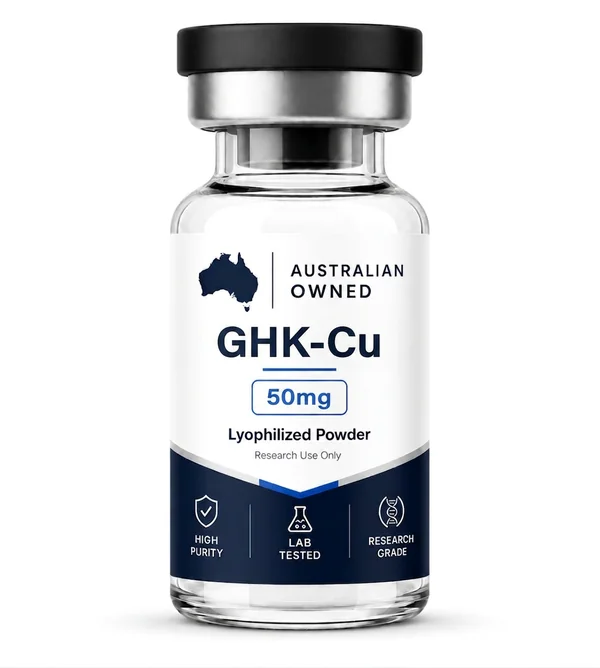
A technical manual for Australian researchers handling GHK-Cu peptide — covers batch analytics, storage parameters, reconstitution protocols, and domestic sourcing benchmarks.
Within Australian academic and laboratory environments, ghk cu peptide remains one of the most widely evaluated copper-binding complexes. This reference guide aggregates technical data, analytical verification protocols, reconstitution workflows, and stability metrics essential for research teams evaluating domestic peptide suppliers.
Investigating ghk cu peptide demands a structured quality assurance chain: parcel intake, batch authentication, sterile reconstitution, cold-chain storage, experimental use, and lot retirement. Each phase includes specific preventative controls designed to mitigate standard laboratory failure modes.
Phase 1 — Receiving and Inspecting GHK-Cu Peptide
- Accept and inspect parcels promptly to minimise unnecessary exposure to ambient Australian summer temperatures.
- Cross-reference the packaging lot code directly against the dispatch notice issued for your ghk cu peptide order.
- Perform a macroscopic inspection of the lyophilised ghk cu peptide cake through the vial wall to confirm uniform blue coloration without collapsing or moisture ingress.
- Archive photographic proof of the intact vial, packaging, and accompanying documentation for institutional inventory compliance.
Phase 2 — Quality Assurance & Analytical Verification
Before entering the ghk cu peptide vial into deep freeze storage, confirm the analytical paperwork. Taking sixty seconds to verify documentation safeguards your project against undetectable lot variance.
- Confirm that the vial label, carton code, and analytical COA for the ghk cu peptide lot are identical.
- Check that the HPLC purity report indicates at least 98% purity alongside an unobstructed chromatogram.
- Validate that the mass spectrometry report matches the theoretical molecular weight of ghk cu peptide.
- Record and archive the complete analytical certificate in your laboratory management database.
Practical Tools for Australian Researchers
Access our dilution calculator, published analytical results, and internal research standards.
Phase 3 — Systematic Reconstitution Protocol
| Step | Procedural Action | Laboratory Risk Prevented |
|---|---|---|
| 1 | Acclimate vial and bacteriostatic diluent to ambient room temperature | Thermal shock degrading the lyophilised structure |
| 2 | Disinfect both rubber septa using sterile alcohol swabs | Particulate and bacterial transfer during needle entry |
| 3 | Introduce bacteriostatic water slowly down the interior vial wall | Aerosolisation, violent foaming, and structural denaturation |
| 4 | Gently swirl the vial in circular motions without shaking | Mechanical shear and molecular breakage |
| 5 | Document preparation date and target concentration on the label | Dosing ambiguity in subsequent multi-day experiments |
| 6 | Store immediately at 2–8°C | Accelerated hydrolysis and loss of peptide potency |
Order GHK-Cu Peptide for Laboratory Research
HPLC-certified ghk cu peptide in Australian domestic stock, dispatched same-day via tracked Express Post.
Phase 4 — Storage & Stability Guidelines
- Maintain reconstituted ghk cu peptide in bacteriostatic water strictly at 2–8°C under continuous refrigeration.
- Utilise the working solution within its demonstrated stability threshold, generally spanning 28 to 42 days.
- Prepare sterile single-use aliquots at the time of mixing if an assay runs over multiple weeks to avoid repetitive septum punctures.
- Shield reconstituted ghk cu peptide from continuous ambient light and sudden temperature spikes.
Phase 5 — Material Accounting & Lot Depletion
Once a vial of ghk cu peptide has concluded its working lifecycle, log the remaining volume and procedural disposal under its parent batch ID. This maintains an unbroken audit history, guaranteeing that future research orders operate under consistent documentation standards.
Phase 6 — Replenishing GHK-Cu Peptide Inventory
Ordering replenishment batches from Klow Peptide ensures continuity across study phases, supported by Australian warehousing, batch-level testing certificates, and dependable logistics. If upcoming phases require alternative quantities or compound formats, contact our support team beforehand to coordinate inventory requirements.
Speak with the Klow Peptide Team
Have questions regarding lot authentication, cold-chain handling, or bulk order logistics? Contact our Australian team.
Frequently Asked Research Questions
Is it acceptable to keep unreconstituted ghk cu peptide at ambient room temperature?
Unopened lyophilised cakes withstand brief ambient transit without degradation. However, long-term storage of ghk cu peptide should remain at -20°C in an airtight vial.
What is the expected working lifespan of reconstituted ghk cu peptide?
When reconstituted using bacteriostatic water and held at 2–8°C, ghk cu peptide generally retains chemical stability for 28 to 42 days, depending on storage conditions.
What measures apply if a ghk cu peptide shipment arrives overheated?
Photograph the condition of the shipment, alert our support desk within 24 hours, and request an evaluation. Klow Peptide replaces orders affected by verified thermal transit failures.
Can researchers freeze ghk cu peptide once reconstituted?
Repeated freeze-thaw cycles should be avoided to prevent cryodamage to the peptide structure. Preparing single-use aliquots at initial reconstitution is recommended if sub-zero storage is required.
How should researchers track partial ghk cu peptide vials across continuous trials?
Record the preparation date, solution concentration, volume drawn during each session, and the assigned batch identifier to tie every draw back to the master COA.
Where can laboratories inspect current ghk cu peptide analytical reports?
Our Lab Results portal provides public access to independent testing reports for current ghk cu peptide batches, and physical COA documentation accompanies every shipment.
Procure Tested GHK-Cu Peptide Today
High-purity ghk cu peptide held in Australia, packed securely for next-business-day Express Post dispatch.