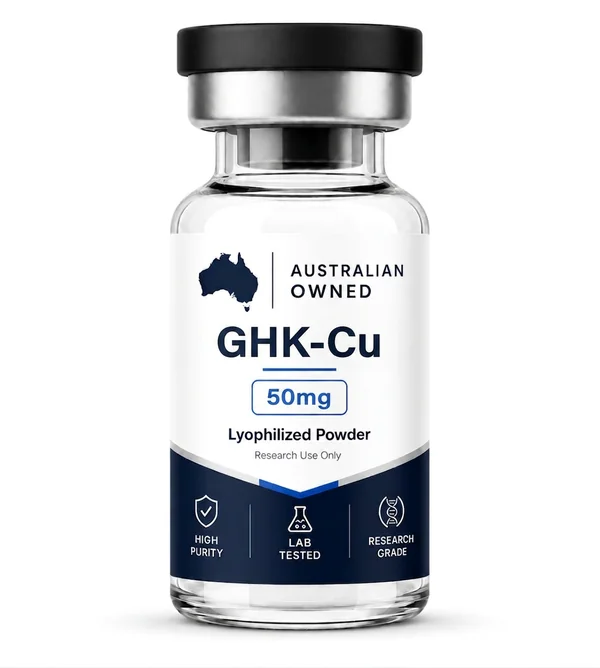
A comprehensive laboratory reference on sourcing, reconstituting, and storing GHK-Cu for Australian in vitro research protocols.
Within the domestic biochemical sector, ghk cu remains among the most frequently cited copper-binding tripeptides. Designing robust experimental assays requires precise insight into reagent purity, handling requirements, and regulatory transparency. This overview synthesizes published structural data, preparation standards, stability parameters, and vendor assessment criteria for Australian research institutions.
While ghk cu is broadly indexed in peer-reviewed literature for its cellular signalling and extracellular matrix interactions, in vitro outcomes rely heavily on physical reagent integrity. Australian investigators require verifiable lot data rather than generic theoretical profiles to guarantee experimental reproducibility across serial trials.
Mechanistic Context and Biochemical Benchmarks
The tripeptide-copper complex glycyl-L-histidyl-L-lysine:copper(II) demonstrates affinity profiles that dictate specific bench handling. Before initiating cell culture or enzymatic assays, investigators routinely evaluate published binding dynamics alongside degradation pathways in aqueous environments to plan their reconstitution parameters.
The Necessity of Independent Batch Analysis
Variable handling, trace synthesis by-products, or improper cold-chain custody can compromise lyophilised material before it reaches your facility. Two vials labelled ghk cu may diverge markedly in optical density, net peptide content, or solubility. Dedicated lot-specific testing bridges this variable, ensuring the compound matches nominal assay specifications.
Essential Reconstitution & Quality Utilities
Calculate target concentrations and verify third-party analytical reports before preparing your assays.
Essential Verification Records for Laboratory Acquisition
| Record Type | Assay Function | Review Stage |
|---|---|---|
| Certificate of Analysis | Validates specific lot purity and confirmed identity | Prior to vial unsealing |
| HPLC Trace Data | Quantifies relative chromatographic purity and resolves impurities | Prior to reconstitution |
| Mass Spectrometry (MS) | Matches experimental mass-to-charge ratios to theoretical values | Prior to reconstitution |
| Cold-Chain Audit Log | Ensures temperature control throughout storage and transit | Upon intake inspection |
| Reconstitution Record | Documents diluent batch, target molarity, date, and technician | During preparation |
Source Verified GHK-Cu for Experimental Use
Explore domestic inventory with batch-matched HPLC and MS testing documentation.
Step-by-Step Reconstitution Guidelines
- Allow the lyophilised ghk cu container and sterile bacteriostatic water to equilibrate to ambient room conditions.
- Disinfect the septum surfaces of both containers utilizing fresh 70% isopropyl alcohol swabs.
- Introduce the measured volume of diluent slowly along the interior glass wall to minimise mechanical foaming.
- Gently rotate the vial in a horizontal plane until the blue lyophilisate fully dissolves into a uniform solution without vortexing.
- Annotate the vial with the final molarity, preparation date, technician ID, and corresponding batch code.
- Place the prepared solution at 2–8°C promptly and utilise within the established experimental stability window.
Thermal Preservation and Stability Parameters
- Lyophilised form: Maintain at -20°C in an airtight container shielded from light for long-term viability.
- Reconstituted form: Store at 2–8°C using sterile preserved water; typical experimental stability ranges from 28 to 42 days based on benchmark literature.
- Cryogenic cycling: Repeated freeze-thaw procedures degrade peptide integrity; sub-aliquoting immediately after dissolution prevents thermal degradation.
Connect with Klow Peptide Support
Our Australian support desk assists with logistical queries, batch documentation requests, and bulk institutional requirements.
Domestic Procurement Standards via Klow Peptide
Klow Peptide stocks ghk cu locally within Australia to remove overseas customs hold-ups and unmonitored thermal exposure during international transit. Every lot is paired with accessible analytical records, and our Australian support team operates during local business hours to facilitate rapid institutional compliance.
Frequently Asked Questions
Where are current lot test results for ghk cu published?
Batch-specific analysis reports are catalogued on our Lab Results page, and physical verification sheets are included with every dispatch from Klow Peptide.
What chromatographic purity benchmark does Klow Peptide require for ghk cu?
Every production batch must demonstrate a minimum of ≥ 98% HPLC purity prior to clearance, with typical batches measuring above 99%.
What is the recommended storage temperature once ghk cu is solubilised?
Aqueous preparations in bacteriostatic water should be preserved at 2–8°C, remaining viable for 28–42 days depending on experimental protocol guidelines.
Can laboratory teams review analytical reports before initiating an order?
Yes. Current batch analytical data is accessible online. For archived lot verification or protocol records, reach out directly to support@klowpeptide.com.au.
Is ghk cu approved for clinical, therapeutic, or personal use?
No. All products distributed by Klow Peptide are strictly intended for in vitro experimental procedures and non-clinical laboratory research.
Why choose verified domestic supply over unaccredited international sellers?
Klow Peptide guarantees end-to-end traceability with unique lot identifiers mirrored on the vial, packaging, and third-party analytical records, backed by rapid domestic dispatch.
Ready to Acquire GHK-Cu for In Vitro Protocols?
Rely on verified Australian inventory backed by rigorous batch documentation and dedicated domestic service.